
How Much Does Palm Tree Removal Cost in Florida?
Two national cost guides put the national average for palm tree removal at $525. One says palms up to 60 feet tall cost $150 to $900 to remove. For Florida, both guides list the same range: $130 to $900. Very tall palms run higher, up to $1,500 in both guides.
Those are market numbers, not our price list. A Sharper Image Tree Services takes palms down from Tampa north to Crystal River. We price each palm after we see it. For a real price on palm tree removal, call or text (813) 293-2948 for a free estimate.
Taking down an oak or a pine instead? Our Florida tree removal cost guide covers those trees.
What does palm tree removal cost by height?
Taller palms cost more. One national guide says they need larger equipment and more safety measures. A second national guide prices palms in these height bands.
| Palm height | Market range in one national cost guide |
|---|---|
| Up to 15 feet | $100 to $200 |
| 15 to 30 feet | $150 to $450 |
| 30 to 60 feet | $200 to $950 |
| 60 to 80 feet | $300 to $1,200 |
| Over 80 feet | $1,100 to $1,500 |
The first guide differs in two rows: $200 to $900 at 30 to 60 feet, and $700 to $1,500 over 80 feet.
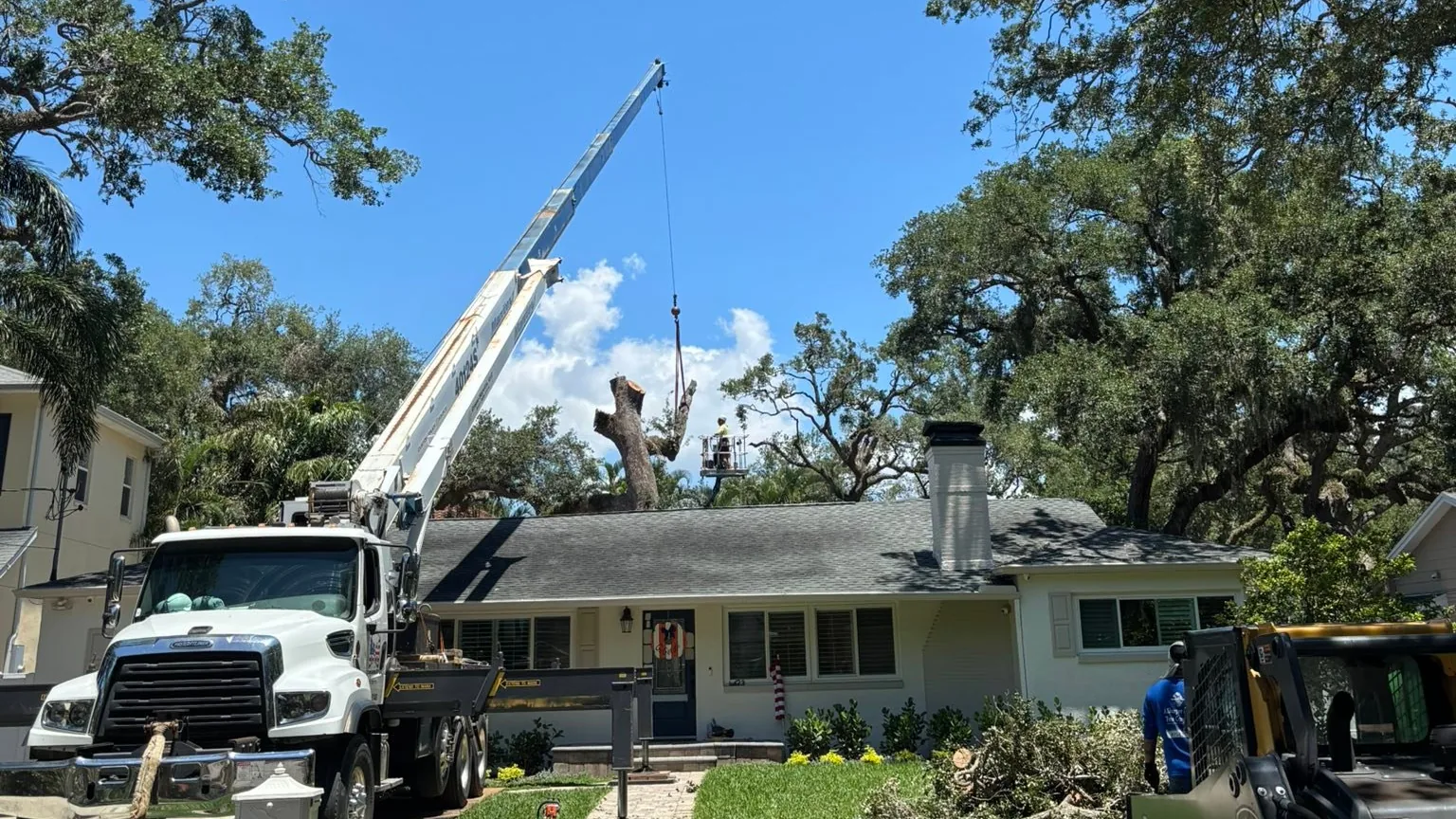
The equipment changes with each band, the second guide says. A climber with a chainsaw and a rope handles palms up to 15 feet. From 30 to 60 feet, a palm is too tall for a ladder or rope. Lifts or a bucket truck come in. From 60 to 80 feet, cranes join the list.
Over a roof or a pool cage, our crane can lift a palm clear. In a back yard, our tracked lift or a climber with rigging reaches the top.
What does palm stump removal cost?
Both national guides price the stump as an extra. One lists palm stump removal at $80 to $250. The other puts it at $175 to $550, plus hauling and any permits.
On request, we grind palm stumps below ground level with our stump grinder. Our stump grinding page covers palm stumps and root balls.
What else changes the palm tree removal price?
One national guide lists these other price factors.
- What stands under the palm. Palms close to buildings, power lines or a fence need ropes or pulleys to come down safely. That adds labor time. Work near a power line is the utility’s job first.
- Trunk width, spread and spikes. Palms with a wide trunk, a big spread or many spikes cost the most to remove.
- Neglected fronds. Regularly trimmed palms have fewer loose fronds and come down more easily. If your palm is healthy and only needs dead fronds off, see our palm tree trimming page instead.
- Several palms at once. Cutting down several trees in one visit reduces the cost per tree.
- Hauling and disposal. The guide lists hauling and disposing of the wood at $200 to $300 on average. Ask whether your estimate includes it. We haul the fronds and the wood off on our trucks.
How much does it cost to cut down a palm tree after a storm?
Storm work costs more. One national cost guide puts emergency palm removal at an average of $2,500, or $250 per hour. Hurricane season runs June 1 to November 30, and storm season fills the schedule fast.
Not every storm-stripped palm has to come out. A UF/IFAS Extension publication says palms grow differently than other trees because they have one terminal bud. If that bud is not damaged, a palm may lose all its fronds and still survive.
The same publication says queen and Washington palms have shown poor survival in south Florida hurricanes. Another UF/IFAS publication lists the sabal palm among the best survivors of Hurricanes Erin and Opal in 1995. An ISA Certified Arborist or the UF/IFAS Extension office can judge whether a damaged palm is worth keeping.
For a palm on the roof or across the driveway, our emergency tree service makes the property safe first. We have worked with homeowners insurance companies on storm jobs, and we document the damage before we cut.
Does a diseased palm cost more to remove?
It can, mostly in the stump and the disposal. UF/IFAS Extension publications cover the two diseases below.
Ganoderma butt rot. All palms are considered hosts, and UF/IFAS says there are currently no cultural or chemical controls for it. UF/IFAS advises removing a palm as soon as possible after conks, hard shelf-like growths, appear on the trunk. Many diseased palms die without producing any. UF/IFAS also advises removing as much of the stump and root system as possible, or grinding the stump. Where possible, the diseased lower trunk and any conks go to a landfill or an incinerator, not into mulch.
Lethal bronzing. UF/IFAS says this disease was first identified in late 2006 in Hillsborough County, in the Tampa area. Sap-feeding insects spread it, and pruning tools cannot pass it along. Once a palm shows symptoms and tests positive, it should be removed immediately.
Leave the diagnosis to an ISA Certified Arborist or the UF/IFAS Extension office.
Do you need a permit to remove a palm tree in Florida?
It depends on where the palm grows. One national cost guide puts a tree removal permit at $40 to $200 on average.
- Unincorporated Hillsborough County exempts queen palm from its tree removal permit, except in a wetland or water body. Where a permit is needed, the application fee is $81.65.
- The City of Tampa lists queen palm among its common invasive or unprotected species. Tampa, Temple Terrace and Plant City run their own tree permits.
- Unincorporated Pasco County exempts palms from its residential tree removal permit.
- Unincorporated Hernando County excludes palms from its tree removal permit.
- Unincorporated Pinellas County, which includes Palm Harbor, requires a permit on many properties to remove palms over six feet tall. On homesteaded single-family lots, the county says trees more than 24 inches in diameter need a permit. These rules took effect January 23, 2026.
- Everywhere else, including Citrus County, ask the city or county before you cut. The same goes for other palms in Tampa and Hillsborough.
The sabal palm, also called the cabbage palm, is Florida’s state tree. Section 15.031 of the Florida Statutes gives it that title and says nothing about removal. Permit rules come from your city or county.
A state law, s. 163.045 of the Florida Statutes, covers a tree that is a danger on residential property. The documentation is a signed onsite assessment from an ISA certified arborist or a Florida licensed landscape architect. With it, a local government may not require a permit or replanting to remove the tree. Our tree removal permit guide covers the county rules.
How do you get a real price for your palm?
Call or text (813) 293-2948 for a free estimate. Photos of the palm help us plan the visit. We look at the palm and what stands under it, then give you a written estimate.
We work from our shops in Tampa and Homosassa, across Hillsborough, Pasco, Hernando and Citrus counties. See how our palm tree removal service works before you call.