
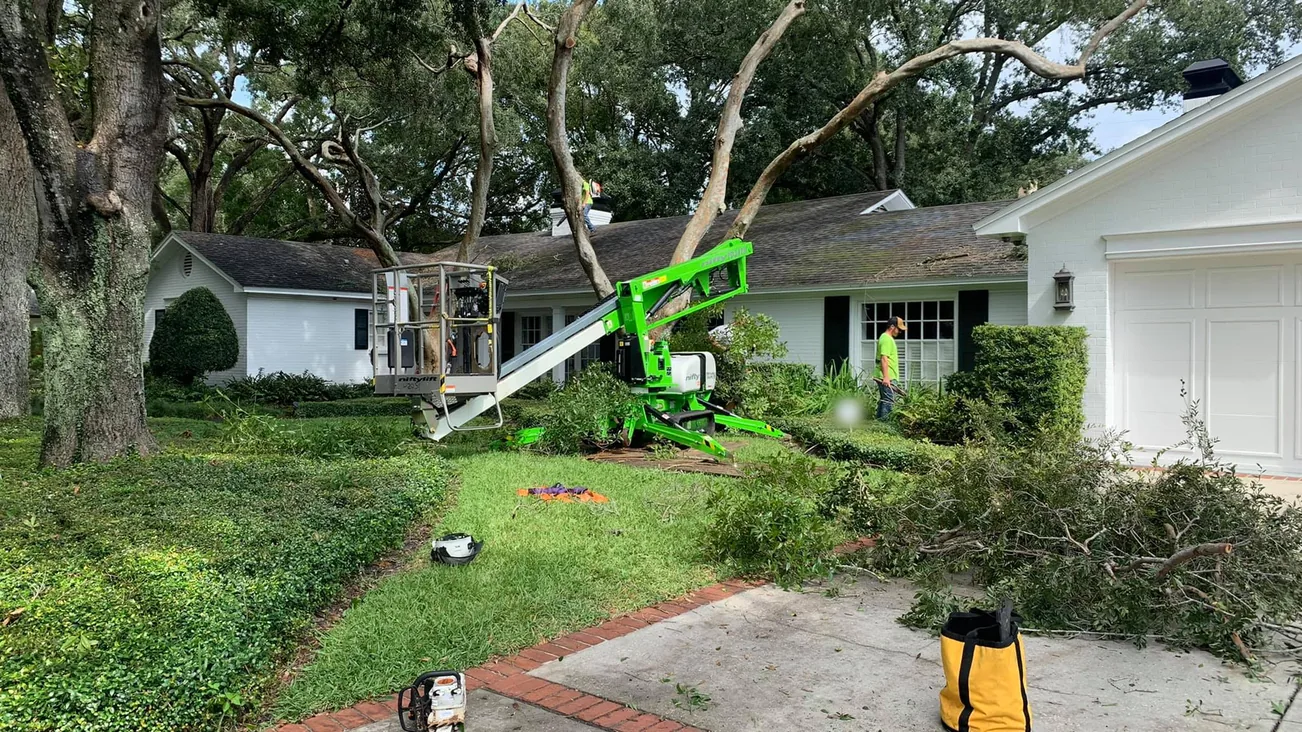
Do You Need a Permit to Remove a Tree in Tampa and Hillsborough County?
Usually, yes. Inside the City of Tampa, most trees 5 inches DBH or larger need a city permit to come out. DBH is the trunk diameter measured 4.5 feet above the ground. In unincorporated Hillsborough County, yard trees 12 inches DBH or larger on a developed single-family lot need a permit.
The main exception is a state law for high-risk trees on single-family home lots, section 163.045 of the Florida Statutes. We do tree removal from Tampa north to Crystal River, so Pasco, Hernando and Citrus get sections too. It is general education from the code pages, not legal advice. Confirm with your city or county before anyone cuts.
Which rules apply where your tree stands?
It depends on whether the address is in a city or the unincorporated county. Hillsborough County points owners to the property appraiser’s records for that. The table shows the rules for a typical home lot.
| Where is the tree? | Which trees need a removal permit? | What else applies? |
|---|---|---|
| City of Tampa | Most trees 5 inches DBH and up | Grand trees, 32 inches and up, get extra review. |
| Unincorporated Hillsborough County | Yard trees 12 inches DBH and up | The fee is $81.65 per parcel. |
| Unincorporated Pasco County | Native trees 5 inches DBH and up | Palms and pines except longleaf are exempt on single-family lots. |
| Unincorporated Hernando County | Trees 18 inches DBH and up | Palms and sand pines are excluded. |
| Unincorporated Citrus County | None on a lot with a home | On vacant land, permits come only with plans to build. |
| Any single-family home, s. 163.045 F.S. | None with a qualifying risk report | See the state law below. |
| Inside a city limit | Check with the city | Temple Terrace, Plant City, New Port Richey and Brooksville run their own. |
How do Tampa’s tree rules work?
Tampa’s tree rules sit in Chapter 27 of the City Code, starting at section 27-284. Chapter 13 is now marked reserved. Any tree 5 inches DBH or larger is protected unless the city lists it as exempt. Brazilian pepper and the queen palm are on that list.
Tampa’s biggest protected trees are grand trees. These are listed species, like live oak and laurel oak, at 32 inches DBH or larger. A grand tree that is not hazardous may need a Variance Review Board or City Council decision, after public notice.
Removals carry mitigation: replacement trees, or a payment into the city’s tree fund if the lot has no room. City Council sets the fees by resolution, so check the current amount online.
Trimming, which the code calls pruning, needs a permit only at 24 inches DBH and up. All tree trimming in the city should meet ANSI A300. Removals for a pool, an addition, a shed or a new house go through the building permit instead.
Can a hazardous tree in Tampa come down sooner?
Yes. When a tree poses an immediate risk to life or property, the code lets it come down before the permit. The permit must follow within 3 working days. Trees wrecked by storms fall under that same rule, which is where emergency tree service fits.
A grand tree that city staff rate as hazardous can also get a removal permit. The applicant completes public notice, including mailed notice. Staff then decide within 20 calendar days of the notice affidavit.
What does Florida’s dangerous tree law allow?
Section 163.045 passed in 2019 and was amended in 2022. It covers only a single-family detached home on a lot actively used as one. If a tree there is documented as an unacceptable risk, no local permit, fee, notice or replanting can be required.
The law requires an onsite assessment that follows Best Management Practices: Tree Risk Assessment, Second Edition (2017). It must be signed by an ISA Certified Arborist or a Florida licensed landscape architect. Unacceptable risk means removal is the only practical way to bring the risk below moderate.
Tampa asks owners to send the signed report to the city to avoid a notice of violation. Hillsborough County wants a copy for its records, and Pasco County may ask for one. The law does not cover mangroves. If you already have a certified arborist’s report, we can work from it.
What does unincorporated Hillsborough County require?
Outside Tampa, Temple Terrace and Plant City, the county’s Natural Resources staff run tree permits. That covers places like Lutz, Brandon, Riverview and Town ‘n’ Country. On a developed single-family lot, yard trees 12 inches DBH and larger need a permit. Trees in a wetland or conservation area fall under the Environmental Protection Commission of Hillsborough County.
Grand Oaks, oaks 34 inches DBH and up in good condition, carry stricter rules. Some species need no permit at any size, such as the camphor tree and Brazilian pepper. Permits go to trees that are unhealthy or causing damage that cannot be fixed another way.
The permit costs $81.65 per parcel, not per tree, for the first 5 acres. A result can take up to 3.5 weeks. A certified arborist affidavit cuts that to about 5 days, except for Grand Oaks. Permit fees are one line in what tree removal costs in Florida.
What are the rules in Pasco County?
Pasco County rewrote its tree code, Section 802, in March 2026. In unincorporated Pasco, removing a tree 5 inches DBH or larger takes a permit unless an exemption applies. On single-family lots, palms and pines other than longleaf pine are exempt, and so are invasive trees.
The county wants a code reason, such as a hazard trimming cannot fix, and rules out allergies and leaf drop. Replanting comes with every permit unless waived, and reviews average 3 to 4 business days. Pasco has no lot clearing permit, so bare land needs a site development permit first. New Port Richey runs its own tree code.
What does Hernando County require?
Hernando County requires a Tree Removal Permit before specimen or majestic trees come down. Specimen trees measure 18 inches DBH or more, and majestic trees 36 inches or more. Palms and sand pines are excluded. The county may allow a protected tree’s removal when it poses an immediate safety hazard or causes property damage. Spring Hill follows county rules, and Brooksville issues its own permits.
Does Citrus County require a tree removal permit?
Usually not for a home lot. Citrus County’s tree code, updated in March 2025, protects trees 4 inches DBH and up. It exempts removal on residential lots with a home on them. Dead, fallen, irreversibly diseased and invasive trees are exempt too, and the county asks for proof of their condition. On vacant land, permits come only with plans to build. Inside Crystal River or Inverness, check with the city.
What should you do before a tree comes down?
Start with the address, city or unincorporated county. Measure the trunk 4.5 feet up: wrap a tape around it and divide by 3.14. A 40-inch circumference works out to just under 13 inches DBH. Photograph any decay or damage. If the state law route fits, get the signed report before any cutting.
Then call or text (813) 293-2948 for a free estimate in writing. We can walk you through the permit page, and the permit is sorted out before work starts. From there, our tree removal crew takes the tree down and hauls the wood away.